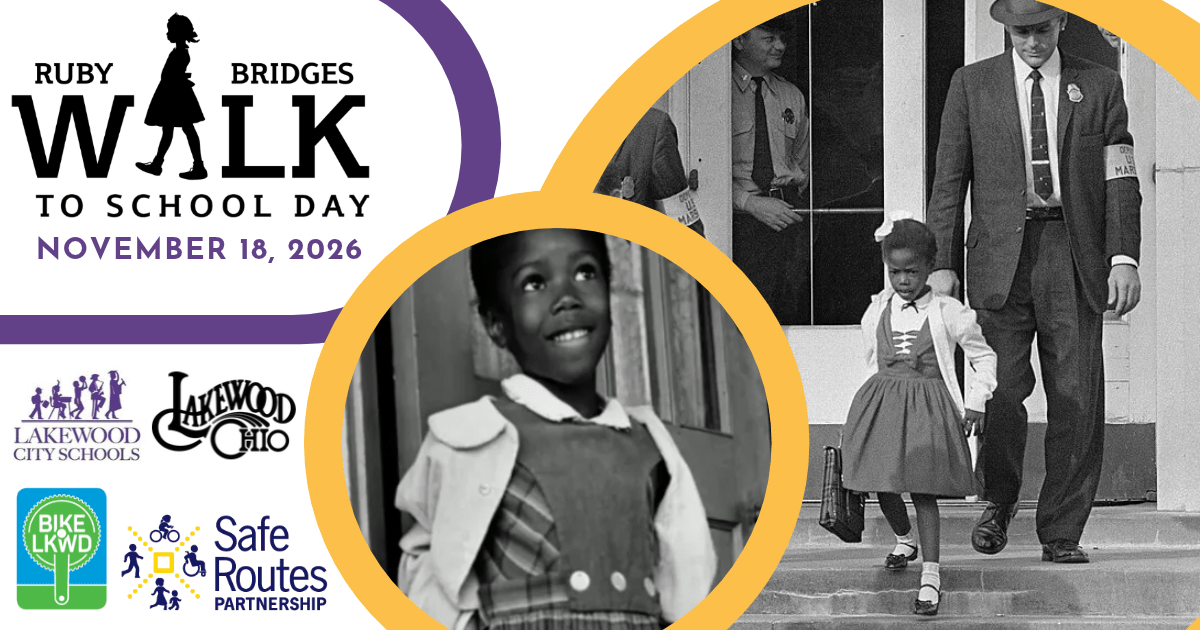
Ruby Bridges Walk to School Day
In 2026, when we think about what it takes to create Safe Routes to School in Lakewood, Ohio, most people think about things like the need for more crossing guards, improvements to pedestrian and bicycle infrastructure (particularly around intersections), and increased enforcement around schools to deter speeding, red-light running, and illegal turning movements. In short, one of the greatest threats to our children’s safe arrival at school today is the automobile.
But on November 14, 1960, a six-year-old girl named Ruby Bridges faced an entirely different set of dangers on her way to first grade at the previously all-white William Frantz Elementary School in New Orleans, Louisiana.
In kindergarten, when Ruby attended a segregated school called Johnson Lockett, she walked to school every day, even though it was “fairly far from [her] house.” She recalled having “lots of company” because “all the kids on [her] block went [there]” (Bridges, 1999, p. 10). She remembered Johnson Lockett as “a regular school with lots of other kids to play with,” where she made new best friends and had a nice teacher (Bridges, 2022).
When it was time to start at William Frantz, however, she could not simply walk there with the neighborhood children like other kids for two main reasons. First, on the block where she lived, “everyone was black” (Bridges, 1999, p. 8), and Ruby was to be the only African American child slated to attend the school after passing a test that was “set up so that kids would have a hard time passing” (Bridges, 1999, p. 11). Second, angry mobs of racist protesters were surrounding the school entrance.
Instead of making the short, five block walk to school, Ruby and her mother were driven there by a U.S. marshal. Before exiting the vehicle at the school, they were instructed to stay inside the car and let the marshals exit first (Bridges, 1999, p. 15). Once outside, four armed marshals surrounded Ruby and her mother, then escorted them into the building. At the end of the school day, which Ruby spent entirely in the principal’s office, she recalls hearing a song promoting segregation and seeing signs that “said awful things,” as well as a coffin with a black doll inside, “which frightened [Ruby] more than anything else” (Bridges, 1999, p. 20). All of this happened as they were escorted back to the marshals’ car. Ruby later wrote, “I don’t even think they saw a child. All they saw was the color of my skin. I was black, and that meant I didn’t matter” (Bridges, 2020, p. 14).
On her second day of school, Ruby and her mother were driven to school again. As they entered the building, protesters spat at them and shouted horrible racist slurs. One woman even threatened to poison Ruby and continued making that threat every morning (Bridges, 1999, p. 22). But it was also the first time Ruby met her young, white teacher from Boston, Mrs. Henry. She taught Ruby, and only Ruby, for the entire year. Neither Ruby nor Mrs. Henry ever missed a day (Bridges, 2020, p. 16). Ruby later wrote:
“I felt safe and loved, and that was because of Mrs. Henry, who, by the way, looked exactly like the women in that screaming mob outside. But she wasn’t like them. She showed me her heart, and even at six years old I knew she was different…I knew that if I got safely past the angry crowd outside and into my classroom, I was going to have a good day.” (Bridges, 2020, p. 18)
After that second day, her mother told her that she couldn’t accompany her to school anymore and that she would have to go by herself with the marshals in their car (Bridges, 1999, p. 22). Meanwhile, most white families had withdrawn their children from the school in protest. The white students who did attend school were hurried inside through a back entrance, assigned separate teachers, and kept far away from Ruby’s classroom (Bridges, 1999, p. 28). Ruby wasn’t allowed in the schoolyard with the other students, and she ate lunch in her classroom all by herself but then later with Mrs. Henry. She remembers that lunchtime was a lonely time and that she wished she could go to the cafeteria to eat the food she could smell from her classroom with the other children (Bridges, 1999, p. 48). Even her trips to the restroom required a federal marshal’s escort (Bridges, 1999, p. 22).
In the days and weeks that followed, neighbors would watch for the marshal’s car to arrive and, once Ruby was safely inside, would “walk behind the car, looking for signs of trouble as the car slowly left the safety of the block” (Bridges, 1999, p. 38). Sometime during the spring, the marshals stopped driving Ruby to school. In the last months of first grade, “a taxi driver was sent to pick [her] up every morning” (Bridges, 1999, p. 52).
By the time Ruby began second grade, neither marshals nor taxi drivers drove her to school. As she recalled, “In second grade, I was on my own” (Bridges, 1999, p. 52).There were no crowds of protesters outside, but when she went inside, she also discovered that Mrs. Henry was no longer a teacher at the school. Ruby later wrote:
“For a long time, I was tempted to feel bitter about the school integration experience, not understanding why I had to go through it and go through it alone. Now I know it was meant to be that way. People are touched by the story of the black child who was so alone.” (Bridges, 1999, p. 60)
More than six decades later, our schools are now integrated. But Ruby’s story still invites us to consider two important questions: What does it take to ensure that every child can get to school safely and feel welcome and respected once they arrive? And whose responsibility is it to make that possible?
Ruby reminds us:
“Racism is a grown-up disease, and we ‘adults’ must stop using you, our kids, to spread it. None of you is born into the world racist. It is we adults who pass racism on. In so many ways, we have failed you by not setting the example you deserve. I have always believed it is our role as grown-ups to guide, lead, and teach our children…to set the best example…just as you must do as you grow up.” (Bridges, 2020, p. 36)
In Lakewood today, every child has the opportunity to attend a neighborhood school, and many families walk or bike to school every day. But a child’s ability to make that journey independently depends on the conditions we create for them.
A child approaching a crosswalk should be able to trust that drivers will stop. A family walking along a neighborhood street should not have to step into traffic because pedestrian infrastructure is missing, damaged, or blocked. A student riding a bicycle should have access to safe routes and appropriate bicycle parking at school.
These are not simply inconveniences for families. They are issues of access, independence, and equity. Children who cannot safely walk or bike to school become dependent on adults and automobiles for transportation, even when they live within walking and biking distance of their school.
Safe Routes to School is about changing those conditions. It is about recognizing that children are legitimate users of our streets and that their safety must be considered when we make decisions about transportation infrastructure, traffic enforcement, and school access.
Ruby Bridges’ walk reminds us that getting to school is not something we should take for granted. Every child deserves the opportunity to travel along a comfortable route, enter their school safely, feel welcome once they arrive, and receive a quality education.
Help Us Recognize Ruby Bridges’ Legacy in Lakewood
Ruby Bridges Walk to School Day is an opportunity not only to remember Ruby’s courage and the history of school desegregation, but also to reflect on our ongoing responsibility to ensure that every child has safe, welcoming, and equitable access to education.
I’m pleased to share that three members of Lakewood City Council have stepped forward to sponsor a resolution recognizing Ruby Bridges Walk to School Day in Lakewood. The resolution is proposed to come before the full City Council for consideration and a vote at its December 7, 2026 meeting.
Ruby’s experience in 1960 cannot be equated with the challenges children face navigating their routes to school today. But her story reminds us that the work of building inclusive communities and ensuring that every child is welcomed and supported is ongoing. Recognizing this day is one way we can carry that commitment forward.
Join us at 7:30 in the City Hall Auditorium on December 7, 2026 to support the Ruby Bridges Walk to School Day Resolution. Your presence would help demonstrate that safe, welcoming, and equitable access to education is a shared community priority.
Continue the Conversation at Home
Ruby Bridges’ story gives families an opportunity to talk with children about courage, kindness, fairness, and the importance of making sure everyone feels safe and welcome on their way to school and once they arrive.
In recognition of Ruby Bridges Walk to School Day on November 18, Bike Lakewood, Lakewood City Schools, and the City of Lakewood invite families to continue that conversation at home by exploring these resources:
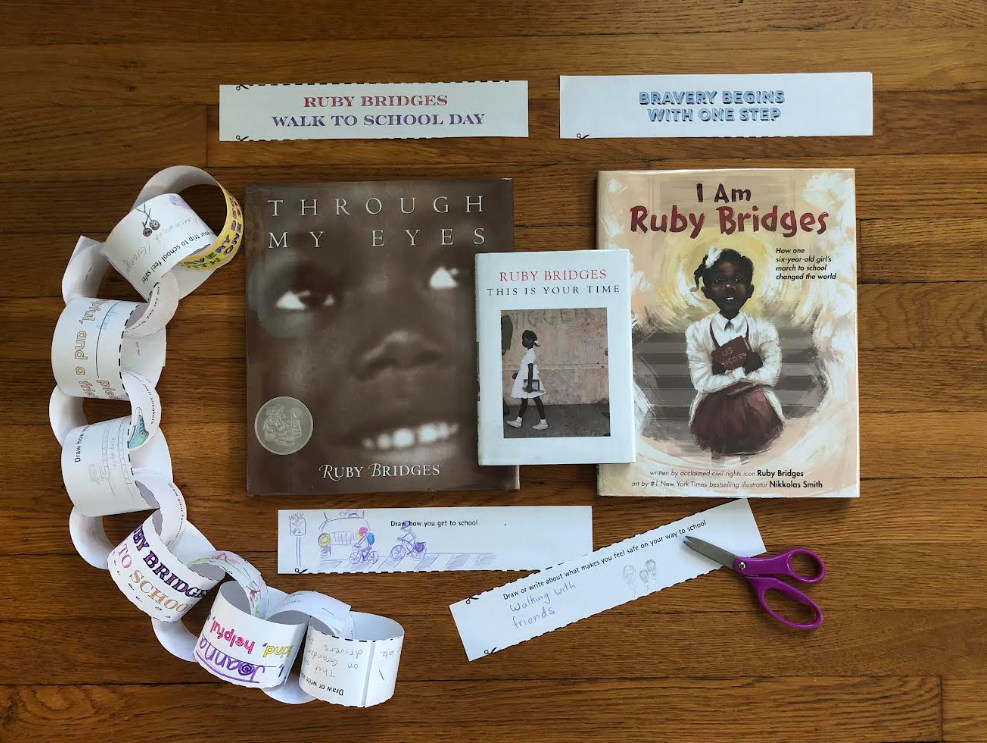
Read together: Read one or all of these fantastic books written by Ruby Bridges herself.
Listen and learn: Listen to Brave Little Ruby, an original song about Ruby’s story written by Emily Lindberg, Bike Lakewood’s Education and Outreach Chair and a librarian specializing in children’s services.
Create together: Complete the paper-chain activity created by Bike Lakewood and adapted from the Safe Routes Partnership.
This printable activity encourages children and caregivers to think about what makes a school journey safe and what makes a school community welcoming. Families can work together to complete the prompts, cut out the paper strips, and connect them to create a paper chain representing their shared ideas and commitments.
Whether it’s making sure drivers stop for pedestrians, helping keep sidewalks clear, welcoming a new classmate, or advocating for safer streets, every link represents a way we can help create a community where all children feel safe and welcome.
Download the free printable Ruby Bridges Paper-Chain Activity (PDF)
References
Bridges, R. (1999). Through my eyes. Scholastic Press.
Bridges, R. (2020). This is your time. Delacorte Press.
Bridges, R. (2022). I am Ruby Bridges. Orchard Books.